Saturday, July 30, 2011

Largest wooden trestle . . .


The Koksilah River Trestle, known locally as the Kinsol Trestle, was officially reopened July 28, 2011 after extensive renovation and rebuilding following an arson fire that destroyed a good portion of it. 


It was built by the Canadian Northern Pacific Railway (later part of CN Rail) and completed in 1920. It is the largest free-standing wooden trestle in the Commonwealth and one of the largest in the world. Built to cross the Koksilah River near Kinsol Station, it is 44m (144 ft) high and 188m (617 ft) long. The name Kinsol is a contraction of the name of the King Solomon Mine nearby. The trestle was last used by a train in 1979 and closed the next year.

With the reopening of the Kinsol Trestle, the Trans-Canada Trail is now complete between Sidney and Duncan, BC.

Tuesday, July 26, 2011

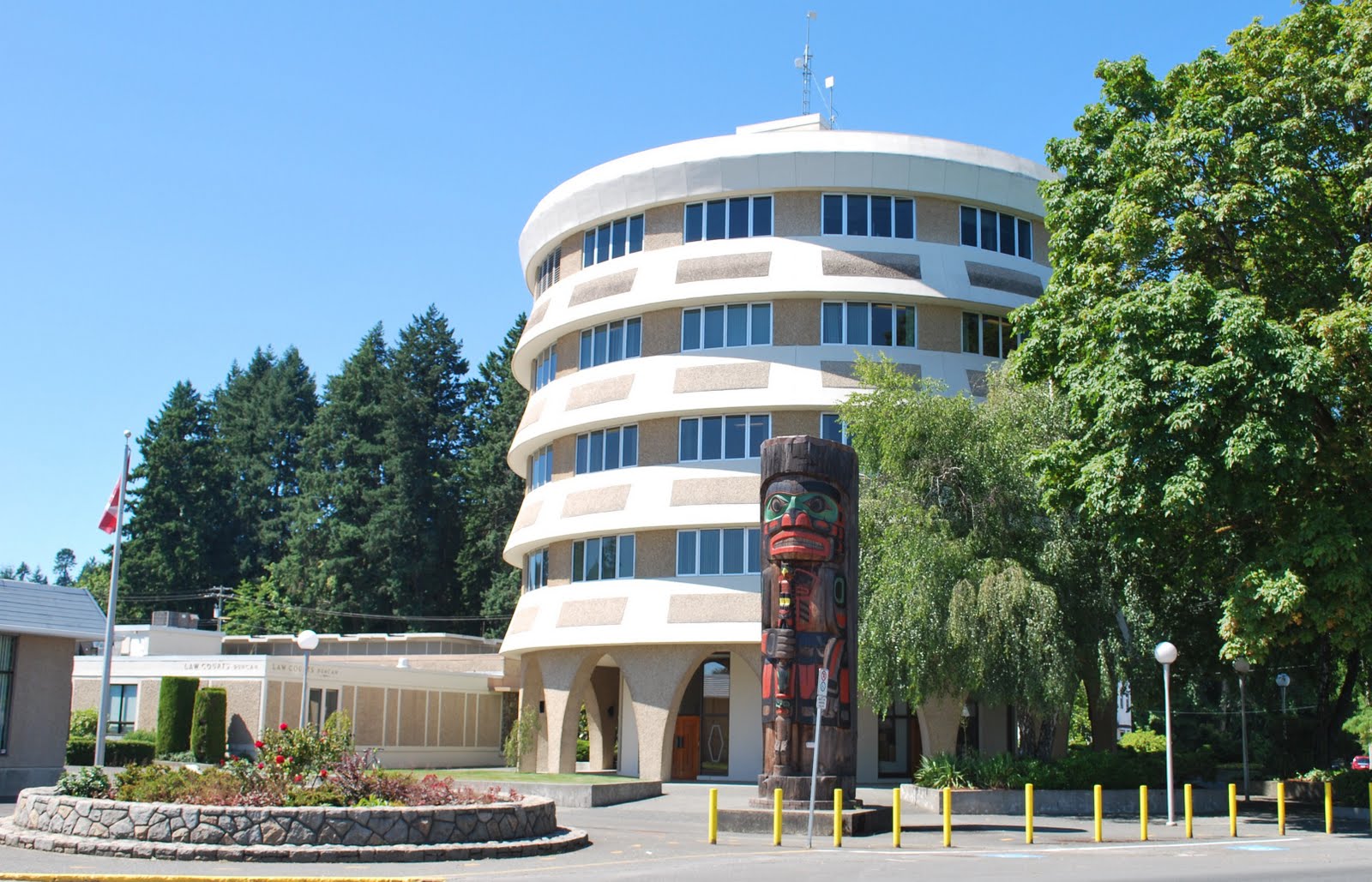
Round building . . .

Province of BC
Courthouse and Government Offices
238 Government St
Duncan, BC

The latest incarnation of the Provincial Court House and Government Offices in Duncan, BC was completed in 1970.  It was built where Duncan's Chinatown once stood.  Many of the former Chinatown buildings were moved south of town and are the nucleus today of Whippletree Junction.

The building was opened by Premier W.A.C. Bennett on October 21, 1970


Monday, July 25, 2011

Alone for eternity . . .

Chapman's Grave
Telegraph Road,
Cobble Hill, BC

I happened upon this grave a number of years ago.  I spotted it by chance in the corner of my eye as I was travelling a backroad near Cobble Hill BC. 
It is very unusual to find lone graves by the side of the road on Vancouver Island.

"William Richard CHAPMAN
Nov 23, 1866 - Nov 1, 1885"


Note: Thanks to Cecil b for providing me with this information from the Chapman Family:

"Richard was helping his father with haying, when the young boy was stricken with severe abdominal pains. There was not a doctor nearer than Ladysmith, and Richard died before help could be obtained.

As was the custom in those days, the grave was dug on the family homestead and a picket fence put around it. As the years went by, the grave became neglected and overgrown.

A Boy Scout troop made inquiries as to the origin of the lonely grave, and made it their project to rebuild the fence and paint it."

Wednesday, July 20, 2011

Another anniversary British Columbia . . .

On today's date, in 1871, BC became a full fledged province in the Dominion of Canada. No longer relegated to colonial status, the new province flourished and continues to do so today.

The Province of British Columbia Coat of Arms
In case anyone is confused, how could this be BC's 140th anniversary if we celebrated our 150th in 2008? The answer lies in history (sorry kids). In 1858, the British colonies of Vancouver Island and British Columbia amalgamated into the united colony of BC. Hence, 2008 was the sesquicentennial of that event. Then, in 1871, four years after Canada was founded, BC joined confederation. That was 140 years ago today.

Happy Anniversary (again)!

July 2010: antique car show on the grounds of the BC Legislature

The library wing of the BC Legislature

Saturday, July 16, 2011

Happy birthday Parks Canada

The world’s first national park service is the agency we know today as Parks Canada.  It was established in 1911 as the Dominion Parks Branch under the Department of the Interior.

In honour of National Parks Day today here is a picture of McLean Mill National Historic Site:


Thursday, July 14, 2011

No Lincoln Logs here . . .

Eaglecrest
Qualicum Beach, BC
This charming log home was built as a staff house in the 1930's at Eaglecrest.
In the early 1930s, Major General Alexander Duncan McRAE purchased 260 acres (1.1 km²) of land situated on an ocean front bluff near Qualicum Beach, BC. In 1934 he built a country home constructed of logs that measured 200 feet (60 m) long and 50 feet (15 m) wide. He called his estate Eaglecrest. The home was designed by Vancouver architect C.B.K. Van NORMAN. General McRAE also built staff homes and ancillary farm buildings at Eaglecrest. It is assumed that the staff homes and barn were also designed by architect Van NORMAN. 
This log barn at Eaglecrest housed General McRAE's herd of horses.
General McRAE subsequently took up farming with the purchase of 2,000 acres (8 km²) of additional land near Qualicum Beach. He employed about a hundred men in its operation for the 13 or 14 years that he owned it. He bred sheep and cattle. Princess (later Queen) Elizabeth and her husband, the Duke of Edinburgh, stayed here for a private visit in 1951 during their honeymoon. Unfortunately the main house, later known as Eaglecrest Lodge, burned to the ground in 1969. Today, only the barn and two staff homes remain as examples of the former rustic spledour of Eaglecrest.

General McRAE was a wealthy industrialist, having major holdings in forestry and mining. In 1926 he won a seat in Parliament as the MP for Vancouver North but subsequently lost his seat it in the 1930 election. Prime Minister R.B. BENNETT then appointed General McRAE to the Canadian Senate where he served until his death at age 71.  
Another staff house built at Eaglecrest.
Senator Major General A.D. McRAE was born in November 17, 1874 in Glencoe, ON and died June 26, 1946 in Ottawa, ON). He served in the Canadian Army during World War I.

Wednesday, July 13, 2011

Did you know . . .

. . .  that Vancouver Island has a rich history of Black pioneers?

Cairn commemorating the early Black pioneers of Vancouver Island
This cairn is located in the cemetery of Shady Creek United Church, 7180 East Saanich Rd, Saanichton, BC. It reads:


“Black Pioneers in British Columbia"

"In 1858, nearly 800 free Blacks left the oppressive racial conditions of San Francisco for a new life on Vancouver Island. Governor James Douglas had invited them here as promising settlers. Though still faced with intense discrimination, these pioneers enriched the political, religious and economic life of the colony. For example, Mifflin Gibbs became a prominent politician; Charles and Nancy Alexander initiated the Shady Creek Methodist Church; John Deas established a salmon cannery; and the group formed one of the earliest colonial militia units, the Victoria Pioneer Rifle Corps."

"Historic Sites and Monuments Board of Canada 1999”

I had the good fortune of meeting a descendent of Charles and Nancy Alexander while rambling through the Shady Creek United Church cemetery where this monument is located. She was a charming lady and very knowledgable regarding the Black history of BC.  Her ancestors founded this church.